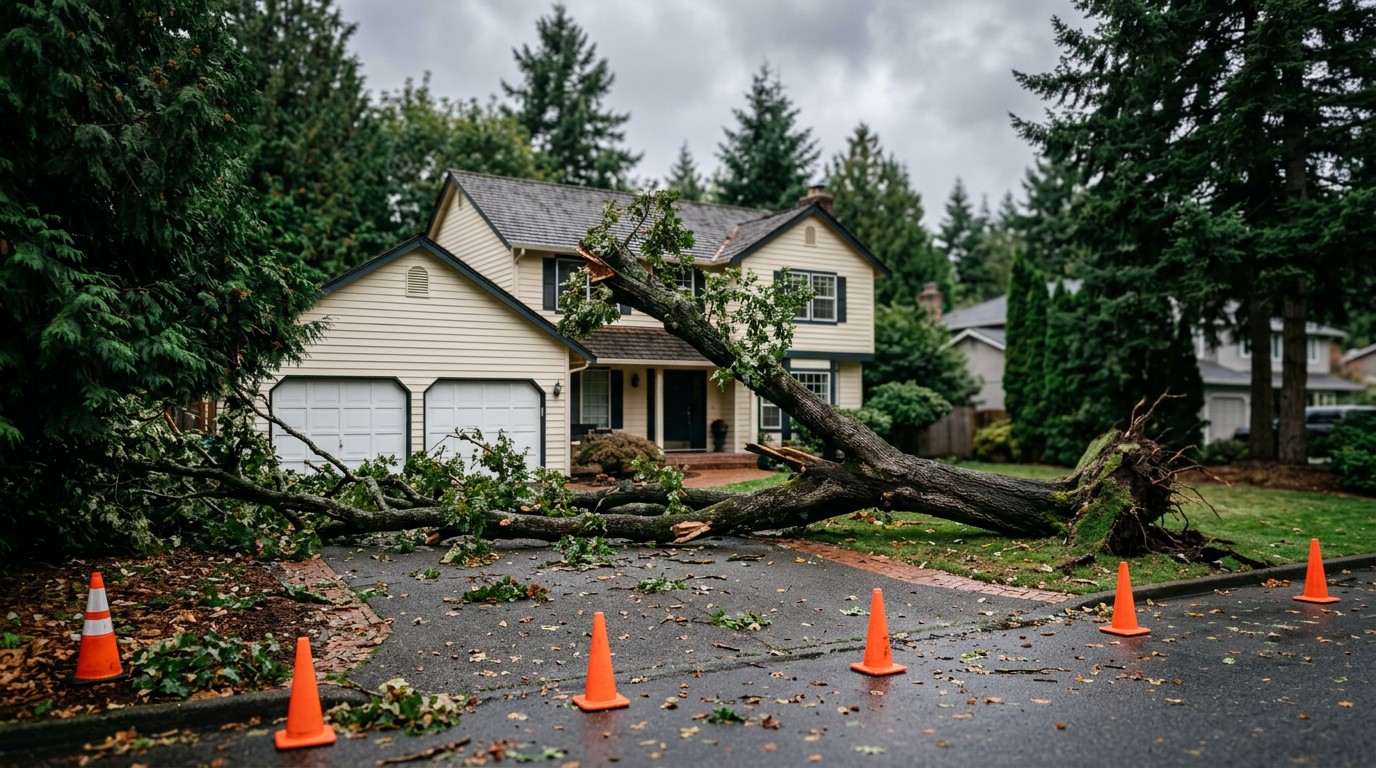
An emergency tree removal is a scheduling problem as much as a tree problem: a limb is on the roof, a trunk is across the driveway, or a leaning tree is threatening the house, and it cannot wait for next week’s calendar slot. That urgency, plus the storm conditions that usually cause it, is why the national cost guides list emergency work well above a routine removal. For standard, scheduled pricing, see our tree removal cost guide; this page covers what changes when the clock is running.
Every figure below is quoted from a named published guide. This is cost context, not safety or insurance advice.
Pricing note - reviewed August 7, 2026: Every figure on this page is quoted from a named published cost guide, each opened on August 7, 2026. These are national published ranges, not local quotes or Arbor Compass averages - emergency work is priced job by job, and prices vary by market. Confirm the itemized total on site with a licensed, insured company.
How Much Does Emergency Tree Removal Cost?
The published pattern is a multiplier on top of standard rates. HomeGuide notes that same-day or next-day tree removal often costs 2 to 3 times the standard rate, and Fixr agrees that an emergency removal could cost up to two or three times more, putting the figure at $450 to $5,000. For a sense of the base those multiples apply to, Angi and HomeAdvisor list standard removal at $200 to $2,000 per tree.
At the top end, several guides converge on the same ceiling. Angi notes it is not unheard of to pay as much as $5,000 in an urgent situation, and HomeAdvisor lists emergency removal running as high as $5,000. Where the fee is billed hourly, Thumbtack lists an emergency surcharge as high as $250 an hour. So the frame is a job that starts at a few hundred dollars for a small, accessible tree and reaches $5,000 for a large, complicated one under pressure.
Why Storm Damage Costs More
The surcharge is not arbitrary - it tracks supply and demand. HomeAdvisor puts it plainly: rates spike after big storms when crews are in high demand. When a single storm drops trees across a whole neighborhood, every crew in the area is booked at once, night and weekend work becomes the norm, and the jobs themselves are harder - trees are tangled in wires, split, or leaning in unpredictable ways rather than standing clean for a planned cut.
That combination is why the same tree that might be a routine removal on a calm week becomes a 2-to-3x job the morning after a storm. The multiplier is the market pricing scarce crew hours and higher-risk conditions, not a single fixed fee.
What Drives an Emergency Quote
The emergency premium sits on top of the same drivers that price any removal, so it helps to see the parts underneath the multiplier.
- The base removal. The surcharge is a multiple of standard pricing, and Angi and HomeAdvisor put standard removal at $200 to $2,000 per tree. A small, accessible tree carries a small base; a large one carries a large one before the emergency markup is even applied.
- Access. A storm-fallen tree is almost never in a convenient spot - it is on a roof, against a fence, or tangled in wires. Angi and HomeAdvisor both list a 25% to 50% premium for a tree in a tight, hard-to-reach, or unsafe location, and LawnStarter lists up to 50%, which stacks with the emergency timing.
- Crane work. A large tree on a structure often cannot be climbed safely and needs a crane. Fixr lists crane-assisted removal at $1,500 to $2,500, and Angi lists the crane at about $500, or $250 to $600 per day, with complex jobs reaching $6,000 to $7,000.
- Debris. Storms leave a mess. Fixr lists debris removal at $150 to $300, and Angi lists hauling at about $70, on top of the removal itself.
Read together, these are why an emergency quote can range from a few hundred dollars for a small, reachable tree to the $5,000 ceiling several guides cite for a large, complicated one.
Working With Your Insurer
Whether storm tree damage is covered, and for how much, depends entirely on your policy and your situation - this is a conversation for your insurance company, not a number this guide can supply. A few neutral, practical steps tend to apply regardless of carrier:
- Document the scene before anything is moved, if it is safe to do so - photos of the tree, the damage, and the surroundings.
- Contact your insurer to ask what your policy covers and what it needs from you before work begins.
- Ask the tree company for a clear, itemized invoice, and keep every receipt tied to the job.
- Confirm the company is licensed and insured before they start, the same as you would for any tree work.
None of that is a coverage promise. It is paperwork that keeps your options open while you sort out the claim with the people who can actually answer it.
Safety Comes First
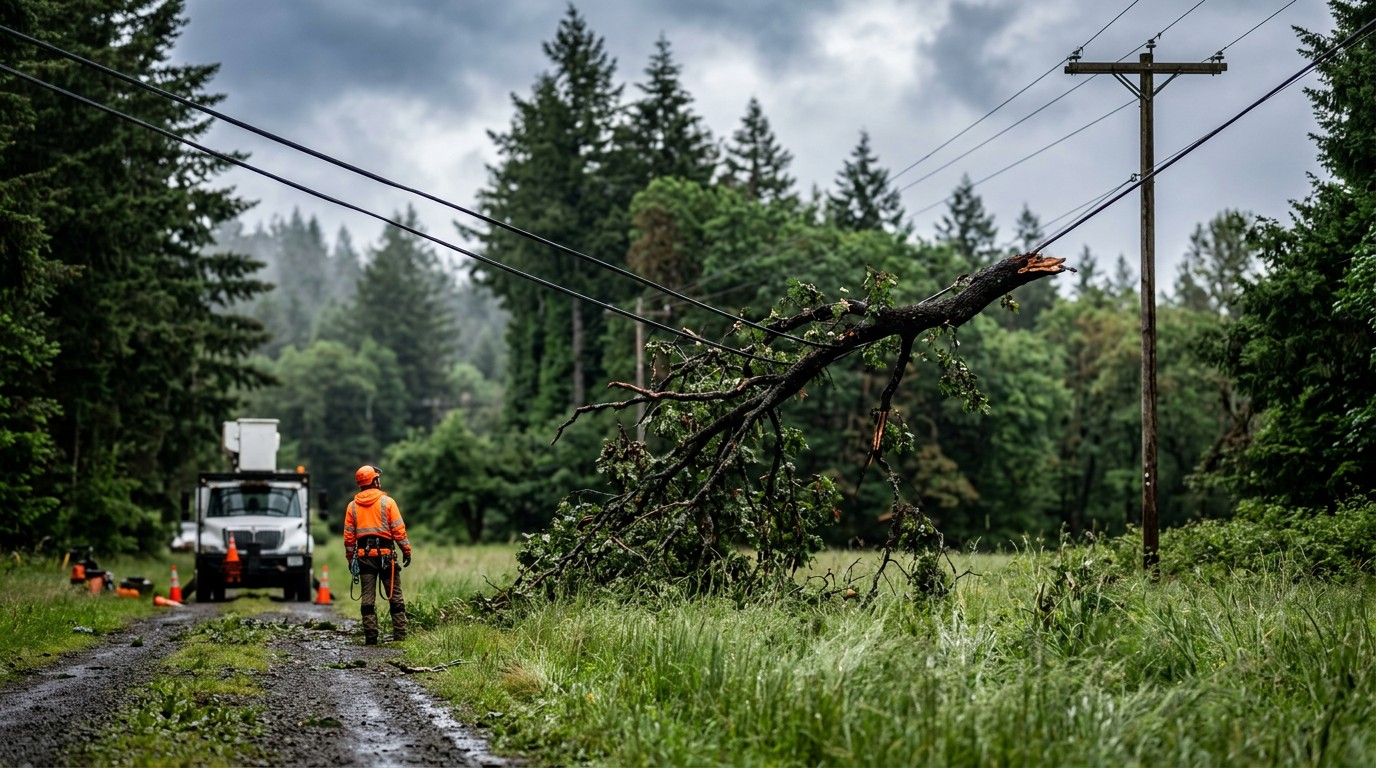
The cost is secondary to the hazard. If a tree is on a structure, resting on or near power lines, or blocking the way out of a home, treat it as the emergency it is and keep people well clear of it. Downed or entangled power lines are a job for the utility and emergency services, not something to approach.
This guide does not walk through how to handle a fallen tree, because that is exactly the work a licensed, insured, professional crew is for. The role of the cost figures here is to help you recognize a fair emergency quote when a crew arrives, not to turn an urgent hazard into a do-it-yourself project. Our emergency and storm damage services page lists crews that take these calls, and the full directory covers your area, including markets like Houston and Denver.
Frequently Asked Questions
How much does emergency tree removal cost?
The guides frame it as a multiple of standard pricing. HomeGuide lists same-day or next-day removal at 2 to 3 times the standard rate, and Fixr lists $450 to $5,000. Angi and HomeAdvisor both list emergency work reaching as high as $5,000, and Thumbtack lists an emergency surcharge up to $250 an hour.
Why is emergency tree removal so much more expensive?
Because urgency and storms drive demand up. HomeAdvisor notes rates spike after big storms when crews are in high demand, and the work is harder and riskier - trees tangled in wires or split rather than standing clean. Fixr and HomeGuide both put the premium at 2 to 3 times a standard removal.
Does homeowners insurance cover emergency tree removal?
That depends on your policy and situation, and only your insurer can answer it. As neutral steps, document the damage before anything is moved if it is safe, contact your carrier to ask what is covered before work starts, and keep an itemized invoice and all receipts. This guide does not offer insurance advice.
What should I do first when a tree falls on my house?
Prioritize safety over cost - keep people clear of the tree and away from any downed or entangled power lines, which are a matter for the utility and emergency services. Bringing in a licensed, insured crew is the safe path; the cost figures here are only to help you judge the quote once help arrives.
Find emergency and storm damage service near you
Compare top-rated companies offering emergency and storm damage service in Houston, Denver, Atlanta, Dallas and Charlotte.
Browse emergency and storm damage service companies →
Service scope and rates vary by company and city - confirm the details with a written estimate directly from the company.